Kashmir has never had to prove that it can grow valuable fruit. Its orchards already produce apples, walnuts, almonds, cherries, saffron, pears and a growing range of horticultural crops that support millions of livelihoods. The bigger question now is what happens after that fruit is grown. On September 21, 2026, growers, buyers and other stakeholders from across the Kashmir Valley gathered at the Sher-i-Kashmir International Convention Complex in Srinagar for a Buyer-Seller Meet chaired by Agriculture Minister Javid Ahmad Dar. The discussions brought an old problem back into focus: Kashmir can produce the fruit, but farmers need a stronger system to store it, process it, transport it, market it and ultimately earn more from it.
For growers, this is not simply an economic policy discussion. It is about what their hard work is actually worth. A farmer can spend an entire year managing an orchard, protecting trees from pests and weather, paying for labour and inputs, and then discover that much of the final value is captured somewhere between the orchard gate and the consumer. Poor grading, weak packaging, limited storage, transportation expenses, uncertain markets and inadequate processing facilities can all reduce the return received by the person who produced the crop. That is why the future of Kashmir’s horticulture cannot be measured only by how many tonnes of fruit are harvested. It must also be measured by how much value stays with the grower.
The horticulture sector already plays a major role in Jammu and Kashmir’s economy. It generates close to Rs 10,000 crore annually and supports more than 35 lakh people, directly and indirectly, across more than seven lakh families. According to the horticulture development roadmap released by NITI Aayog, the sector contributes nearly seven per cent of the Union Territory’s Gross State Domestic Product. Those figures show why improving the horticulture value chain is not a narrow agricultural issue. It is closely connected to employment, rural incomes, logistics, exports, small businesses and the wider regional economy.
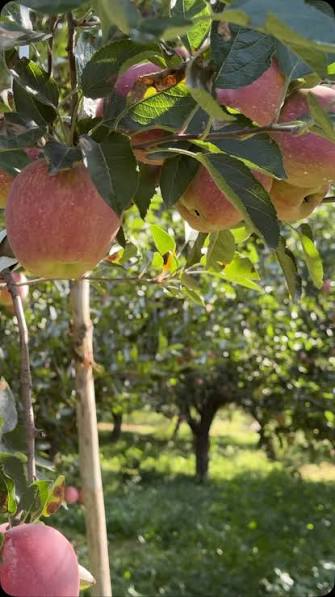
One of the most significant changes is happening inside Kashmir’s orchards themselves. Traditional apple cultivation generally depended on large trees, wider spacing and several years of waiting before commercial harvesting. High-density plantations follow a different model. Dwarfing rootstocks, closer spacing, trellising, canopy management and fertigation can help farmers make better use of limited land and water while improving productivity and fruit quality. This is especially important in Kashmir, where many growers operate on relatively small landholdings and cannot simply expand their acreage whenever they want to increase production.
The numbers show that this transition is already underway. The Economic Survey 2025-26 recorded the distribution of 29.13 lakh high-density plants during 2024-25. The cumulative area under high- and medium-density plantations reached 20,034 hectares. Across the Union Territory, the area under major horticultural crops stands at around 3.47 lakh hectares, while production reached 27.35 lakh metric tonnes up to November 2025. These numbers represent more than a change in planting patterns. They reflect an attempt to make every hectare of agricultural land more productive.
But planting more trees, even high-density ones, cannot by itself transform the sector. Farmers need certified planting material, reliable irrigation, technical guidance, pest surveillance, crop insurance, access to finance and dependable supplies of agricultural inputs. High-density horticulture works best when it is treated as a complete production system rather than simply a programme for distributing new saplings. Without the supporting ecosystem, farmers can be left carrying the risks while the promised productivity gains remain difficult to achieve.
Government policy is increasingly moving toward this broader approach. The Holistic Agriculture Development Programme has allocated Rs 1,028.21 crore for horticulture projects. NITI Aayog’s Roadmap for Horticulture Development, meanwhile, provides a longer-term framework extending toward 2047. One of its central initiatives, Operation Golden Greens, is structured around five sub-missions covering dry fruits, fresh fruits, vegetables, floriculture and minor crops.
Fresh fruits account for roughly 73 per cent of the fruit-growing area and remain at the heart of the region’s horticultural economy. The strategy therefore focuses on improving productivity through high-density plantations while strengthening cold-chain infrastructure, logistics and export capabilities. Dry fruits represent a smaller share of cultivated area, around 27 per cent, but their higher value creates significant opportunities for processing, branding and Geographical Indication-based marketing. The roadmap divides development into phases covering 2026-2030, 2030-2035 and 2035-2047, with the broader ambition of moving the sector from basic production toward deeper domestic and international market integration.
The most important part of that transformation, however, may begin after the fruit leaves the tree.
A good harvest can still become a poor business outcome if the crop is damaged, poorly graded, badly packaged or forced into the market at the wrong time. The NITI Aayog roadmap estimates post-harvest losses in apples at around 25 per cent. For growers, that can represent a substantial amount of potential income disappearing before the product reaches consumers.
Storage infrastructure has improved considerably, but the gap remains significant. Controlled Atmosphere storage capacity in Jammu and Kashmir has increased from approximately 31,000 metric tonnes in 2016-17 to around 2.92 lakh metric tonnes today. Yet the estimated requirement is close to six lakh metric tonnes. The difference makes one point clear: building more storage is important, but storage cannot operate in isolation. Pack houses, grading and sorting facilities, quality-testing laboratories, processing units, transportation networks and reliable market information need to work together.
Digital marketplaces could also change how growers reach buyers. The electronic National Agriculture Market, or eNAM, is designed to connect agricultural markets through online trading, competitive bidding and digital payments. In Jammu and Kashmir, eNAM transactions reached Rs 634.09 crore, covering 28.26 lakh quintals, up to November 2025. The larger opportunity is not simply putting mandi transactions online. Better digital market access can potentially give growers stronger price information and connect them with a wider pool of buyers.
Another major question is diversification. Apples will remain deeply connected to Kashmir’s horticultural identity and economy, but long-term resilience cannot depend entirely on one crop. Walnut, almond, saffron, pear, cherry and apricot already have established markets. Berries, kiwi, selected nuts, vegetables, medicinal plants and aromatic crops could create additional opportunities when matched appropriately with local growing conditions and market demand.
The NITI Aayog roadmap recognises this regional approach by identifying crop and variety opportunities across different agro-climatic zones. Temperate areas can support crops such as cherry and walnut, while intermediate zones may be better suited to crops such as peach and plum. Such planning can help districts move away from a one-size-fits-all approach and make planting decisions based more closely on local conditions, resources and commercial potential.
Floriculture presents another opportunity that extends beyond traditional agriculture. Flowers can connect farming with tourism, landscaping, events and small local enterprises. Government gardens, commercial flower cultivation and projects such as Bagh-e-Gul-e-Dawood show how floriculture can generate economic activity beyond the farm gate. The Economic Survey records 278 parks and gardens and 356.41 hectares under commercial floriculture across the Union Territory.
Yet the road ahead is not without obstacles. Climate variability, pests and diseases, concerns over pesticide residues, dependence on imported planting material, expensive transportation and limited processing capacity continue to challenge growers and businesses. These are problems that cannot be solved through technology alone. They require coordinated investment, practical farmer support and stronger connections between research institutions, government agencies, producers, traders and buyers.
Climate-resilient varieties, precision irrigation, integrated pest management, better testing laboratories, export-certification assistance and stronger farmer producer organisations can all play a role. Producer organisations are particularly important because individual small growers often have limited bargaining power. When farmers can aggregate their produce, negotiate collectively, access larger buyers and participate more effectively in marketing, they have greater opportunities to capture value beyond the farm gate.
Ultimately, Kashmir’s horticulture story is entering a new chapter. The region already has fertile land, experienced growers, globally recognised products and a strong agricultural identity. What it needs now is a connected system that allows those strengths to translate into better and more predictable economic returns.
The shift is therefore bigger than moving from traditional orchards to high-density plantations. It is a shift from production to productivity, from selling raw produce to developing processed products, from hurried harvest-time sales to planned marketing, and from isolated growers to organised producer networks.
Kashmir has the fruit. The next challenge is making sure the value does not disappear along the way.
If production, storage, processing, research, logistics, technology and market access develop together, horticulture can become an even stronger foundation for rural incomes, employment, entrepreneurship and exports across Jammu and Kashmir. The orchard will always be where the story begins. But increasingly, the real economic story will be everything that happens after the fruit is picked.