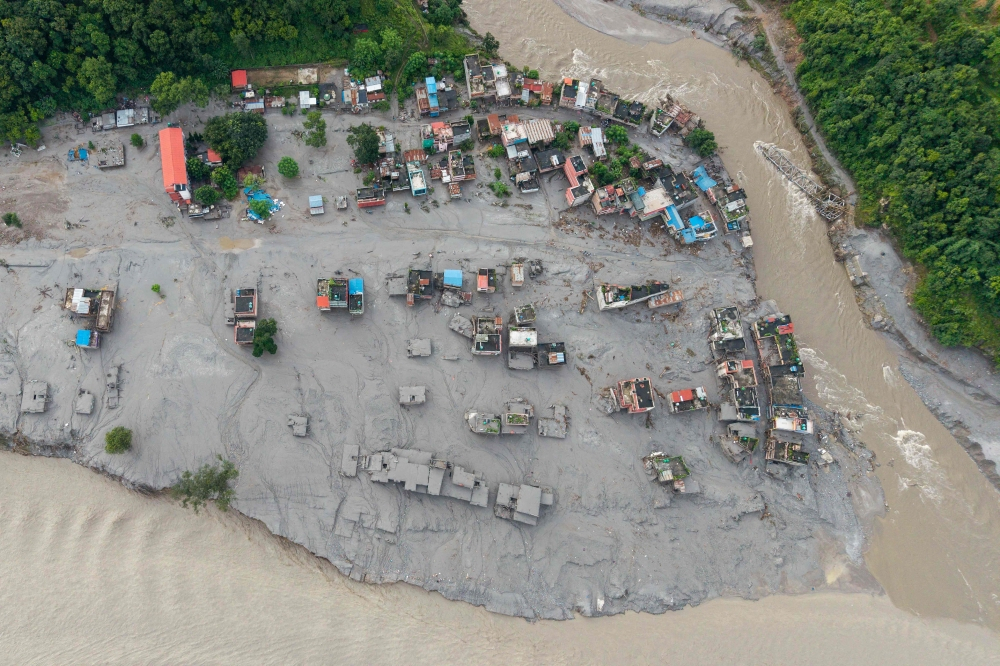
A devastating disaster along the Nepal-Tibet border has left communities facing loss, uncertainty and a desperate search for hundreds of missing people.
Catastrophic floods and landslides sent powerful waves of water, mud and debris through areas on both sides of the border, killing at least 165 people and leaving hundreds more unaccounted for.
The full picture is still developing, and authorities continue to search for victims and assess the scale of the destruction.
What happened?
The disaster unfolded suddenly, with torrents of water and debris rushing downstream on both sides of the Nepal-Tibet border.
Surveillance footage from the Chinese side captured the terrifying force of the disaster, showing a huge wall of mud and water crashing over a building while people desperately ran to safety.
In Nepal, the surge travelled through communities located along the Bhote Koshi and Trishuli rivers, affecting villages, towns and areas visited by tourists.
Early reports described the event differently. Authorities in Nepal initially referred to it as a flood, while Chinese officials described it as a mudslide and debris event.
As rescue teams began working through the aftermath, the likely cause also became clearer.
Hundreds are still missing
At least 165 deaths have been reported so far, including 162 people in Nepal and three in Tibet.
Chinese authorities have described the disaster as involving “major casualties” and reported 558 people missing. Among those reported missing are 260 foreigners.
Nepalese authorities have also reported hundreds of people unaccounted for. A total of 468 tourists were reported missing, including 393 foreign nationals.
The missing people include citizens from India, Ukraine, Malaysia, the United Kingdom, South Africa and several other countries.
Australia has also said that 34 of its citizens were missing in Nepal, while another 93 Nepalese citizens were reported missing.
For families waiting for news, the numbers are more than statistics. Every missing person represents someone’s parent, child, partner, friend or loved one.
International assistance begins
As the extent of the disaster became known, international organisations and governments began offering emergency assistance.
The United States pledged US$500,000 in emergency aid, while the International Federation of Red Cross and Red Crescent Societies released US$1.4 million to support relief operations.
David Fisher, the Nepal head of the organisation, said the immediate priority was reaching communities cut off by the disaster and helping people who had lost homes or suffered injuries.
The European Union activated its Copernicus satellite monitoring system to support assessment and recovery efforts and indicated that additional assistance could be provided.
The World Health Organization also sent emergency medical supplies.
Neighbouring India provided an initial 10 tonnes of humanitarian assistance as rescue and relief operations continued.
What caused the disaster?
The explanation surrounding the disaster changed as experts examined additional evidence.
Initial reports suggested that an earthquake may have triggered a landslide. Nepal’s Foreign Minister Shishir Khanal said an earthquake could have caused a landslide that blocked a river, eventually sending a massive volume of water downstream.
Chinese authorities also reported a landslide and said a border hub between Tibet and Nepal was struck by a powerful surge of debris.
Early information appeared consistent with a seismic event reported by the US Geological Survey in Tibet.
However, further analysis changed that assessment.
The USGS later concluded that the seismic activity initially interpreted as an earthquake was actually associated with a glacial collapse and debris flow. According to the updated assessment, no earthquake had occurred.
The evidence pointed instead toward a glacial collapse followed by a massive debris flow, producing catastrophic impacts downstream.
A disaster that goes beyond the numbers
For people living near rivers and mountain valleys, disasters like this can transform ordinary life within minutes.
Homes can disappear beneath mud and water. Roads can become inaccessible. Communication can be disrupted. Families can become separated, while rescuers face dangerous terrain and difficult weather conditions.
The international response is therefore not only about counting casualties. It is about locating missing people, reaching isolated communities, providing medical care, restoring access and helping survivors begin rebuilding their lives.
The search for those still missing remains one of the most urgent priorities.
As rescue and recovery operations continue, the Nepal-Tibet disaster is a powerful reminder of how quickly conditions can change in mountainous regions and how devastating the combination of water, unstable terrain and collapsing ice can become.
Behind every number is a human story. Families are still waiting for answers, survivors are trying to understand what happened, and rescue workers are continuing their difficult work in the hope of bringing more people home.
Source: AFP