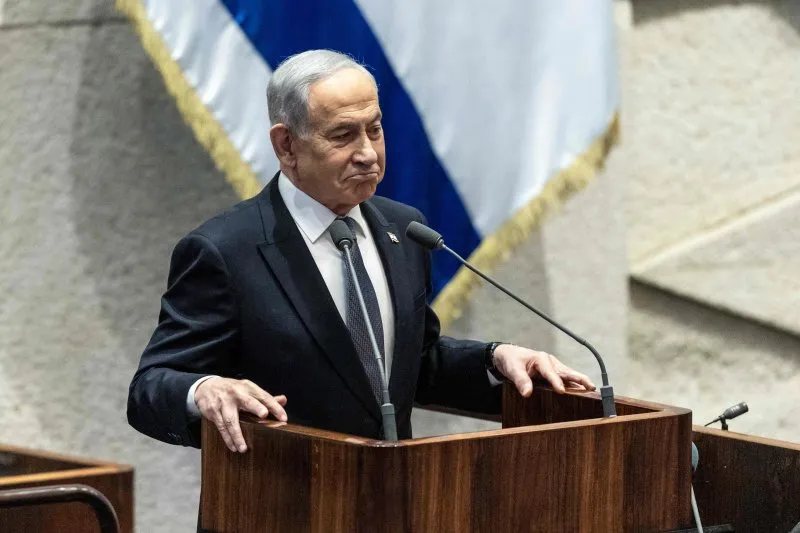
Israel’s political future remains uncertain as caretaker Prime Minister Benjamin Netanyahu and opposition leader Gadi Eisenkot prepare to meet for crucial coalition negotiations following a surprising proposal for a unity government.
The meeting, scheduled for 10 a.m. local time on Sunday in Herzliya, comes after Netanyahu offered Eisenkot the opportunity to become prime minister first under a rotating leadership arrangement. The proposal marks a significant development in efforts to break the political deadlock following Israel’s inconclusive October elections.
Neither of the two main political blocs secured enough parliamentary seats to form a government independently. President Isaac Herzog subsequently tasked Eisenkot with the responsibility of forming a new administration.
Since receiving the mandate, Eisenkot has been working to bring together different political parties to replace Netanyahu. However, his efforts have encountered considerable challenges, particularly over whether to cooperate with Arab-Israeli parties and how to accommodate ultra-Orthodox political groups.
In a statement released late Saturday, Netanyahu’s Likud party confirmed that both leaders had spoken and agreed to meet to discuss the possibility of forming a unity government.
Netanyahu, who has served as Israel’s longest-standing prime minister, presented his proposal through social media, saying he was prepared to put political differences aside and allow Eisenkot to serve as prime minister first, with Netanyahu taking the position of alternate prime minister.
Eisenkot responded by expressing willingness to examine the proposal, provided Likud demonstrated a genuine commitment to political unity.
He said he was prepared to assess the seriousness of Likud’s intentions within the following 24 hours.
Coalition Negotiations Face Major Political Challenges
The proposed unity arrangement comes amid growing frustration over the slow progress of coalition negotiations.
Eisenkot had initially been expected to form an alternative government with parties opposed to Netanyahu. However, he later instructed his centrist Yashar party to explore negotiations with Netanyahu’s right-wing Likud.
The negotiations have not been without tension.
On Friday, Eisenkot accused Likud of deliberately delaying discussions and avoiding meaningful compromises. He claimed that despite more than two weeks of negotiations, the party had failed to present a concrete proposal.
He also stated that Likud had not responded to a detailed proposal submitted by his political camp.
Meanwhile, divisions within Eisenkot’s potential coalition have complicated the situation. Different groups hold competing positions on cooperation with Arab-majority parties, ultra-Orthodox factions and the possibility of establishing a unity government with Likud.
The disagreements have raised questions about whether Eisenkot can secure the parliamentary support required to form a stable administration.
Netanyahu’s Unity Offer Draws Criticism
Netanyahu’s proposal has also faced strong criticism from several political opponents.
Youssef Jabareen, leader of the Arab-majority Joint List, expressed support for removing Netanyahu from power and called for political change through cooperation between Jewish and Arab communities.
Former prime minister and Beyachad co-chair Yair Lapid was also critical of Netanyahu’s offer, describing it as another attempt to mislead political partners.
These reactions highlight the deep political divisions surrounding the negotiations and the difficulty of building trust between rival political groups.
Arab Parties Could Influence the Next Government
Another important development involves Mansour Abbas, leader of the Arab-Israeli Raam party.
Abbas recently indicated that his party could consider joining an Eisenkot-led government, potentially creating a new path toward securing the parliamentary majority needed to form an administration.
His comments came after Raam and the Joint List supported legislation calling for an inquiry into the security failures surrounding the October 7, 2023 attacks. The proposed inquiry referred to Hamas as a terrorist organisation.
Abbas suggested that his party could participate in a coalition either from its formation or at a later stage.
He also acknowledged that explicitly recognising Hamas in such terms had previously been politically sensitive because of its possible implications for relations within Israel’s Arab community and with Palestinians in the West Bank and Gaza.
Eisenkot, however, has made clear that condemning Hamas is among the conditions for cooperation with potential coalition partners.
What Happens Next?
Eisenkot faces a challenging deadline, with December 6 set as the official date for forming a government. He has previously indicated that he intends to meet the deadline without requesting the additional 14-day extension available to him.
His Yashar party has already reached coalition agreements with the left-leaning Democrats and the right-wing Israel Beiteinu party. Together, these parties hold 36 seats in Israel’s 120-member parliament, leaving them well short of the 61 seats required for a parliamentary majority.
The outcome of the Netanyahu-Eisenkot meeting could therefore prove significant in determining the country’s political direction.
Whether the two rivals can overcome their differences, whether Arab parties will participate in a new coalition, and whether a unity arrangement can gain sufficient support remain major unanswered questions.
For now, Israel’s political future depends on negotiations, political compromises and the ability of competing parties to find common ground.
Source: AFP