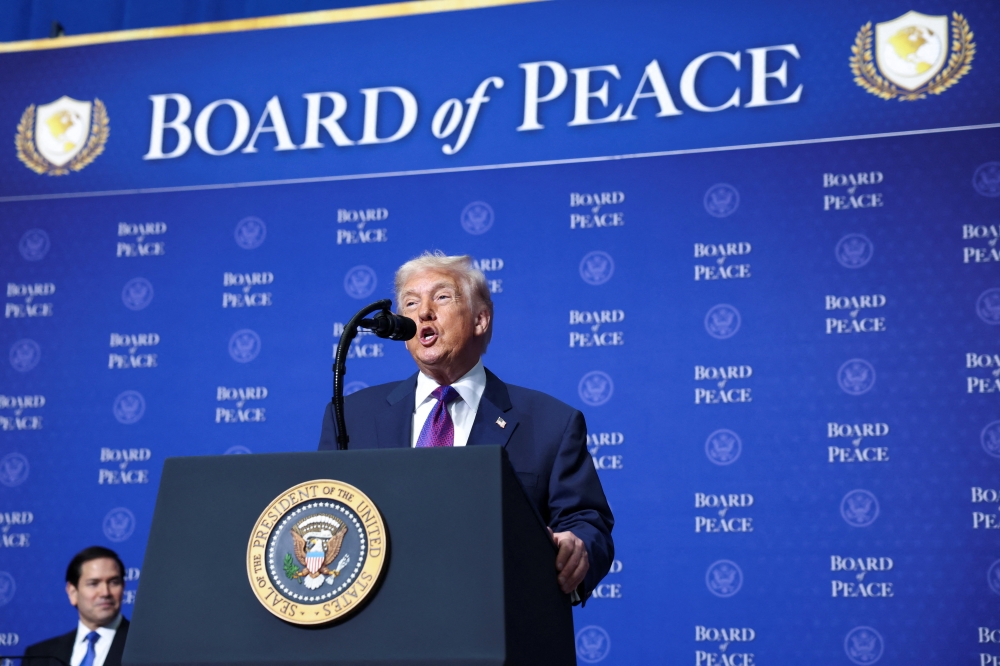
U.S. President Donald Trump has given Iran a 10‑day window to agree to what he calls a “meaningful deal” in negotiations with Washington, warning that failure to reach an agreement could lead to serious consequences.
Speaking at the first meeting of the “Board of Peace” — an initiative focused on promoting stability in Gaza — Trump said that while talks with Iran have historically been difficult, this moment represents a critical chance for progress.
“It’s proven to be over the years not easy to make a meaningful deal with Iran. We have to make a meaningful deal, otherwise bad things happen,” Trump said.
He also cautioned that if a deal isn’t reached soon, the U.S. “may have to take it a step further,” adding that clarity will come “probably over the next 10 days.”
Rising Tensions with Tehran
Trump’s ultimatum came shortly after Israeli Prime Minister Benjamin Netanyahu warned Iran that any hostile action would prompt an unexpected response.
The statements follow a second round of Omani‑mediated talks between the United States and Iran in Geneva, aimed at addressing concerns about Iran’s nuclear program — a topic both sides say they want to resolve, though with different goals.
White House Press Secretary Karoline Leavitt said there are “many reasons and arguments” that could be made for striking Iran, and that Tehran “would be very wise to make a deal with President Trump.”
Trump has previously threatened military action against Iran, citing both domestic unrest and its nuclear activities as points of concern.
Iran’s Response and International Reactions
Iran’s atomic energy chief reaffirmed that no nation can deny Tehran the right to pursue nuclear enrichment — a stance that appears to challenge Washington’s negotiating position.
Iranian officials stress that the talks should focus solely on the nuclear issue. After the latest round of discussions, Iran’s Foreign Minister said both sides agreed on “guiding principles,” though U.S. leaders assert that key red lines remain unresolved.
Iranian President Masoud Pezeshkian emphasized that Tehran “does not want war,” yet indicated that the country won’t easily yield to U.S. demands.
Other countries are reacting to the rising tension. Poland has urged its citizens in Iran to leave immediately, and Germany has reduced its military presence in northern Iraq, citing safety concerns. Meanwhile, Russia is calling for restraint and hopes that diplomacy will continue to play a central role.
Military Posturing in the Region
As negotiations continue, the United States has been deploying significant military assets to the region. This buildup includes warships, fighter jets, and aerial refueling aircraft. A second U.S. aircraft carrier is en route, joining the USS Abraham Lincoln, which is already stationed near the Iranian coast with its complement of aircraft.
In response, Iran’s Islamic Revolutionary Guard Corps conducted war games in the Strait of Hormuz — a key global shipping route through which a large portion of the world’s oil and gas flows.
Analysts caution that any disruption to shipping in the strait could have wide‑ranging effects on global energy markets and economic stability.