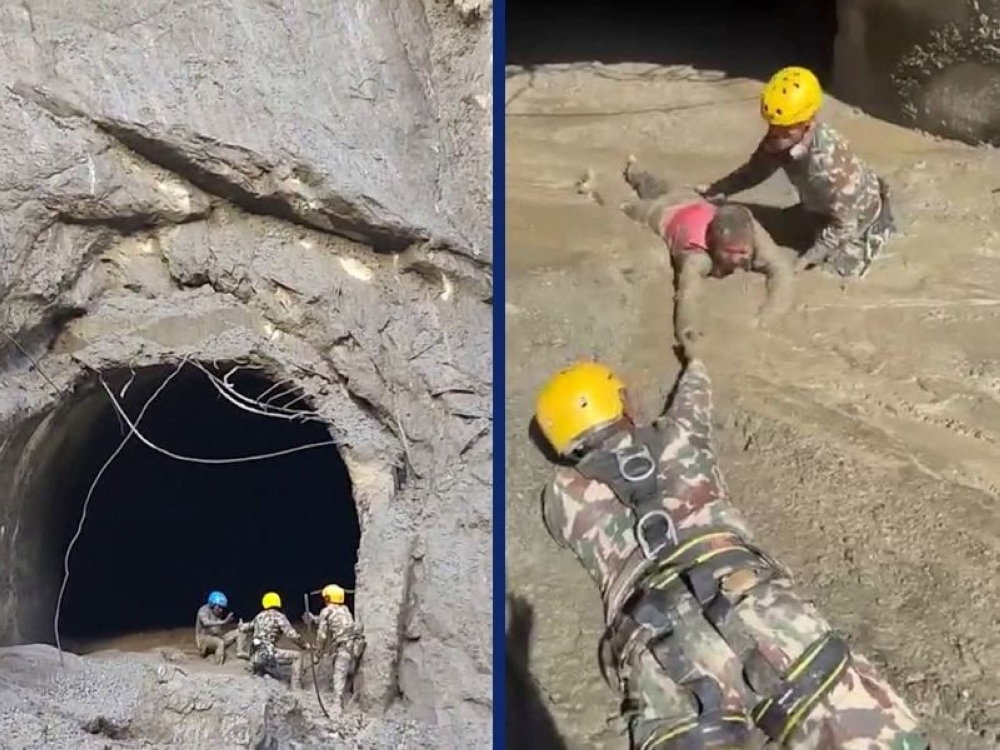
Rescue teams in Nepal are working against time to reach more than 100 workers trapped inside a hydropower tunnel, three days after devastating floods and a massive debris surge struck the area.
Nepali army personnel began using heavy drilling equipment on Saturday as part of an increasingly difficult rescue operation at the Trishuli 3A Hydropower Project in Rasuwa.
The Prime Minister’s Office said efforts to clear the tunnel entrance had been intensified from early Saturday morning. Rescuers are facing thick layers of mud, huge boulders and unstable conditions left behind by the floods.
Photographs released by the government showed rescue workers moving carefully through the mud and debris as they attempted to open a path toward the trapped workers.
Around 82 army and police personnel were involved in excavating the tunnel entrance. Authorities described the operation as extremely challenging, particularly because of continuing adverse weather conditions.
The Nepal Army said its teams were using drilling machines and other equipment to locate and reach the outer section of the tunnel.
The rescue operation comes after hundreds of people were already brought to safety from the affected area. According to Nepalese authorities, army personnel rescued around 350 people from the site on Thursday under highly dangerous conditions. However, more than 100 people were still believed to be trapped inside the tunnel.
India sends specialist tunnel rescue team
As the scale of the operation grows, India has also stepped in to assist Nepal.
Following a request from the Nepalese government, India sent a specialised tunnel rescue team to the Trishuli area. The team is expected to begin by carrying out an aerial survey before determining the safest and most effective way to support the rescue.
India has considerable experience in complex Himalayan rescue operations, including the use of specialised teams trained to enter extremely narrow and difficult-to-access spaces.
For the families waiting outside, every hour is critical.
The trapped workers are among hundreds of people working on hydropower projects along rivers affected by the disaster. Nepal’s National Disaster Risk Reduction and Management Authority said 933 workers were present at hydropower projects in the affected areas when the disaster struck.
A disaster of devastating scale
The flooding and debris surge occurred on Wednesday morning near the Tibet-Nepal border.
The United States Geological Survey said the disaster was linked to a glacial collapse that triggered a powerful torrent of water and debris, causing widespread destruction.
The disaster has left communities across the region facing a heartbreaking situation, with thousands reported missing and hundreds of deaths confirmed.
While rescue crews continue digging, drilling and clearing enormous amounts of debris, the focus remains firmly on those still trapped underground.
For the families waiting for news, the drilling is more than construction equipment at work. It represents a race against time and a narrow but vital hope that their loved ones can still be brought home safely.
The coming hours will be crucial as Nepalese and Indian rescue teams work together in some of the most difficult conditions imaginable.