
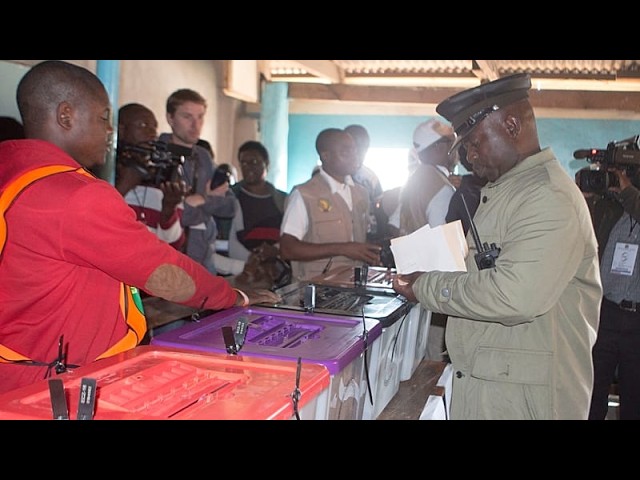
As Zambia prepares for a closely watched presidential election, millions of voters are heading to the polls with two powerful hopes: that the country remains peaceful and that its economic recovery finally becomes more visible in everyday life.
The election comes at a crucial moment for Zambia, one of Africa’s more politically stable democracies. On Thursday, up to 8.7 million registered voters are expected to cast their ballots and decide whether President Hakainde Hichilema deserves another term or whether the opposition has made a strong enough case for change.
At the heart of the election is a question that many ordinary Zambians are asking: Has the country’s economic recovery improved their lives enough to justify staying the course?
Hichilema, leader of the United Party for National Development, came to power in 2021 after defeating the long-ruling Patriotic Front. His victory was widely seen as an important moment for Zambia, marking a peaceful transfer of power through the ballot box.
He inherited an economy facing serious challenges, including sovereign default after years of heavy borrowing under former president Edgar Lungu.
Since taking office, Hichilema’s administration has achieved several important economic milestones. Zambia secured a major debt restructuring agreement, restored its International Monetary Fund programme and returned the economy to growth. These developments have earned recognition from international lenders and investors.
But for many citizens, economic statistics tell only part of the story.
Across communities, households continue to struggle with high food prices, unemployment and persistent poverty. More than 70 percent of Zambia’s population lives on less than three dollars a day, according to World Bank data.
For voters, the question is increasingly personal.
Medical student Semi Malama, 26, summed up the mood by saying that while Zambia’s progress has received international recognition, the government now needs to make sure that progress reaches ordinary people.
That gap between economic recovery and household reality could become one of the defining issues of the election.
Copper, investment and Zambia’s economic future
Zambia is Africa’s second-largest copper producer, making the mining industry central to its economic future.
The government has set an ambitious goal of tripling copper production by 2031, a target that could generate greater investment, employment and government revenue if achieved.
Chinese companies remain major players in Zambia’s mining sector, reflecting the significant role China plays in the country’s economy.
For Zambia, however, increasing production is only one part of the challenge. Many citizens want to know whether increased mining activity will translate into better jobs, stronger household incomes and improved public services.
That question is particularly important for younger Zambians, who represent a substantial portion of the electorate.
A race that has become more competitive
For much of the campaign, Hichilema appeared to have a strong path toward re-election.
That picture changed as opposition parties moved closer together and backed Brian Mundubile, a former minister and former ally of late president Edgar Lungu.
Although 14 candidates are contesting the presidency, political analysts increasingly view the election as a contest primarily between Hichilema and Mundubile.
Mundubile’s campaign has focused heavily on the economic pressures facing families, arguing that the benefits of Zambia’s recovery have not reached citizens quickly enough.
His alliance is also attempting to attract voters who previously supported Lungu’s Patriotic Front, particularly in northern and eastern parts of the country where the former ruling party traditionally enjoyed significant support.
Political analysts say that strategy could give the opposition a stronger foundation, although Mundubile faces the challenge of expanding his support beyond the traditional Patriotic Front base.
His relatively late emergence as the main opposition challenger could also make it harder to build nationwide momentum.
Young voters could shape the result
One of the most important groups in the election is Zambia’s youth.
Nearly half of registered voters are between 18 and 35 years old, giving younger citizens considerable influence over the final result.
Their concerns are likely to include employment opportunities, the cost of living, economic mobility and the possibility of building a more secure future at home.
For many young voters, the election is not simply about political parties or personalities. It is about whether the government can create an economy in which hard work leads to genuine opportunity.
Institute for Security Studies researcher Zenge Simakoloyi described the central choice facing voters as a decision between continuing the current economic reforms or demanding a change in direction to respond more quickly to immediate economic pressures.
That choice may ultimately determine the result.
Concerns over political tensions
While Zambia has maintained a reputation for political stability, the election campaign has not been completely free from tension.
There have been reports of clashes between supporters of rival political groups, with police using tear gas to disperse some confrontations.
The opposition has also accused authorities of restricting its campaign activities.
Mundubile recently alleged that snipers were deployed at a campaign event in Mongu, approximately 580 kilometres west of Lusaka. He described the use of tear gas as only the beginning of what he considered a wider problem.
Such allegations have increased attention on the political environment surrounding the election and raised concerns about restrictions on dissent and the narrowing of political space.
For many Zambians, however, the hope remains that political disagreements will not undermine the country’s long-standing reputation for peaceful democratic transitions.
What happens after voting?
Polling stations are scheduled to open at 6:00 a.m. local time and remain open for 12 hours.
Zambians will not only choose their president. They will also vote for an expanded parliament, with the number of directly elected members of parliament increasing from 156 to 226.
The presidential result is expected according to the electoral commission’s announced timetable, with August 17 set as the date for results.
To win the presidency outright, a candidate must receive more than 50 percent of valid votes. If no candidate reaches that threshold, the leading contenders will face a run-off.
The final result could therefore depend on relatively small changes in voter support across Zambia’s 10 provinces.
More than a political contest
This election represents more than a battle between two political camps.
For Hichilema, it is a test of whether his government’s economic reforms have generated enough confidence among citizens to earn another mandate.
For Mundubile and the opposition, it is an opportunity to turn frustration over living costs and economic hardship into a political breakthrough.
For millions of voters, the decision is much simpler.
They want affordable food. They want jobs. They want economic opportunity. They want political stability. And above all, they want to see national progress reflected in their own homes and communities.
Zambia’s economic recovery may look promising from the outside, but elections are ultimately decided by people and their lived experiences.
As voters prepare to make their choice, the country faces a defining question: Should Zambia continue on its current path and give reforms more time, or is it time for a new political direction?
The answer will shape not only the next government, but also Zambia’s economic and democratic journey in the years ahead.