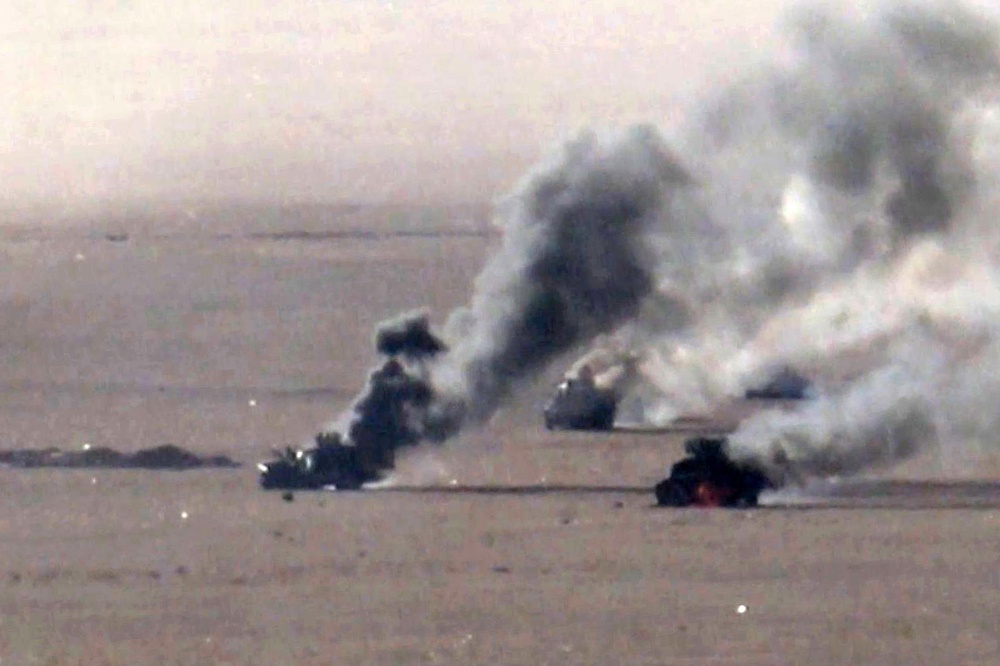
The United States has carried out another round of targeted military strikes against Iran, adding fresh uncertainty to an already tense situation in the Middle East. The latest operation reportedly targeted Iranian air defence systems on Saturday, while diplomatic efforts continued behind the scenes to find a possible way forward and prevent the conflict from escalating further.
US President Donald Trump confirmed the military action, describing it as a limited operation against an Iranian anti-aircraft installation. Speaking to reporters after arriving in West Palm Beach, Florida, Trump said the target had been neutralised within minutes, suggesting that the operation was relatively brief.
Meanwhile, Iranian state media reported explosions on Qeshm Island, located in the strategically important Strait of Hormuz. According to Iran’s IRNA news agency, local witnesses heard aircraft activity before two projectiles reportedly struck the island. The location is particularly significant because the Strait of Hormuz is one of the world’s most important maritime routes for international oil shipments.
The reported developments came after Iranian media, citing the Islamic Revolutionary Guard Corps (IRGC), claimed that Iranian air defence systems had destroyed a US MQ-1 Predator drone over Qeshm Island on Friday night. These incidents highlight the continuing military tensions despite ongoing diplomatic contacts.
The United States had also conducted what it described as defensive strikes earlier in the week. Explosions were reported around Qeshm and Hengam islands, as well as near Bandar Abbas on the Iranian mainland.
Political pressure adds another dimension to the conflict
The latest US military action comes at a politically sensitive moment for President Trump. His Republican Party suffered a major setback in the US midterm elections, losing control of both chambers of Congress, according to the report.
The election outcome has been linked partly to public dissatisfaction with the administration’s handling of the conflict and the economic consequences of the war. Rising fuel prices and wider financial uncertainty have affected businesses, households and industries across the global economy.
Since the election results, Trump has sent mixed signals about the future of the conflict. While he has issued strong warnings against Iran, he has also suggested that diplomatic efforts could bring the war closer to a resolution.
This combination of military pressure and diplomatic engagement has left the international community watching closely for signs of whether the situation will move towards negotiations or another round of confrontation.
Qatar presents new proposals to Tehran
As military tensions continue, Qatar is attempting to bridge the gap between Washington and Tehran.
Two Middle Eastern government officials said Iran was reviewing proposals presented by Qatari mediators concerning disagreements over its nuclear programme and the conditions required for negotiations with the United States.
However, Iran has reportedly made it clear that it is not prepared to enter nuclear negotiations until Washington addresses several key demands.
The nuclear issue remains one of the biggest obstacles to reaching an agreement. President Trump has repeatedly insisted that Iran’s nuclear activities must be addressed as part of any arrangement intended to end the conflict, which has continued for more than eight months.
The White House has not publicly commented on the latest Qatari proposals. Nevertheless, Trump acknowledged that discussions with Iran through mediators were continuing.
US offers reward for information on Iran’s nuclear programme
While diplomatic discussions are taking place, Washington is maintaining pressure on Tehran.
US Central Command announced on Friday that the United States was offering a reward of up to $20 million, along with possible relocation assistance, for information concerning Iran’s nuclear programme.
The announcement covers information about nuclear facilities, equipment, personnel and individuals associated with the country’s scientific community. The initiative was linked to the US State Department’s Rewards for Justice programme.
The announcement illustrates the continuing tension between the two countries, with diplomatic engagement happening alongside security and intelligence measures.
Iran sets conditions before agreeing to nuclear negotiations
Tehran has reportedly outlined several conditions that it wants addressed before entering formal nuclear negotiations with Washington.
Among its principal demands are the removal of the US blockade on Iranian ports, the lifting of economic sanctions, the release of frozen Iranian assets and compensation for damage caused by the war.
Iran has also called for an end to hostilities across the region, including Israeli military operations in Lebanon.
These demands present a significant challenge for negotiators. The United States has previously rejected several of Iran’s conditions, leaving both sides with considerable differences to resolve.
The situation demonstrates that ending the conflict will require more than simply agreeing to resume discussions. Both governments will need to address the underlying political, economic and security concerns that have contributed to the crisis.
Qatar explores a temporary agreement to rebuild trust
One of the most significant developments in the diplomatic process is a proposed temporary agreement designed to create conditions for broader negotiations.
According to regional officials, Qatari mediators have presented a proposal involving a series of confidence-building measures that could be implemented over two days.
Under the reported arrangement, the first day would involve lifting the US blockade on Iran and releasing some of the billions of dollars in Iranian assets frozen under American sanctions.
In return, Iran would allow International Atomic Energy Agency (IAEA) inspectors to access nuclear facilities previously struck by the United States and Israel.
The second day would focus on reopening the Strait of Hormuz under a modified arrangement reportedly discussed between Iran and Oman. The proposed mechanism would serve as a temporary framework until a longer-term agreement involving other Gulf countries could be negotiated.
If these initial measures are successfully implemented, Washington and Tehran would move towards more comprehensive discussions covering Iran’s stockpile of highly enriched uranium and other aspects of its nuclear programme.
The proposal remains part of ongoing diplomatic discussions, and its implementation has not been confirmed.
Iran’s uranium stockpile remains a major international concern
Iran has consistently maintained that its nuclear programme is intended for peaceful purposes. However, international concerns remain over the country’s uranium enrichment activities.
According to the International Atomic Energy Agency, Iran has accumulated 440.9 kilograms of uranium enriched to 60 per cent purity. This is significantly above the enrichment level commonly associated with civilian nuclear power generation and technically close to the 90 per cent level generally considered weapons-grade.
The issue has become central to negotiations because Washington wants stronger assurances and safeguards concerning Iran’s nuclear activities.
Allowing international inspectors to access sensitive facilities could therefore become an important step towards rebuilding confidence between Tehran and the international community.
Regional leaders intensify diplomatic efforts
Beyond Qatar, several countries across the Middle East are increasing diplomatic engagement in an effort to prevent further military escalation.
Qatar confirmed that its defence minister, Sheikh Saoud bin Abdulrahman Al Thani, held discussions with US Defence Secretary Pete Hegseth regarding developments in the region.
The Qatari government also confirmed a separate conversation between President Trump and Qatar’s emir, during which efforts to reduce tensions were discussed.
Iranian Foreign Minister Abbas Araghchi has also been actively engaging with regional counterparts. On Friday, he held telephone discussions with officials from Iraq and Tunisia concerning the situation and possible diplomatic pathways.
According to Iraq’s News Agency, Araghchi discussed Tehran’s position on restarting negotiations with the United States during his conversation with Iraqi Foreign Minister Fuad Hussein.
Egypt has also called for greater flexibility from both sides. Egyptian Foreign Minister Badr Abdelatty stressed that compromise would be essential to preventing another wave of regional instability.
He also spoke with his Emirati counterpart, Abdullah bin Zayed Al Nahyan, highlighting the importance of political negotiations over further military confrontation.
The world watches as military action and diplomacy continue
The latest developments underline how complicated the situation between the United States and Iran has become. Military operations, nuclear disagreements, economic restrictions and competing political demands are all influencing the possibility of a peaceful resolution.
The Strait of Hormuz adds another layer of international concern. Any prolonged disruption to this strategic waterway could affect global oil supplies, shipping costs, energy markets and international trade. The economic consequences would not remain limited to the Middle East.
For countries dependent on imported energy and international shipping, including many across Asia, developments in the region deserve particular attention.
Qatar’s mediation efforts offer a possible diplomatic opening, but major differences remain between Washington and Tehran. Whether the proposed confidence-building measures can lead to meaningful negotiations will depend on the willingness of both governments to make compromises.
Ultimately, the consequences of this conflict extend far beyond the two countries involved. Millions of people, international businesses and global markets have a stake in what happens next.
The biggest question now is whether diplomacy can move faster than military escalation. The coming days could prove important in determining whether the region moves closer to a negotiated settlement or faces another period of uncertainty and confrontation.