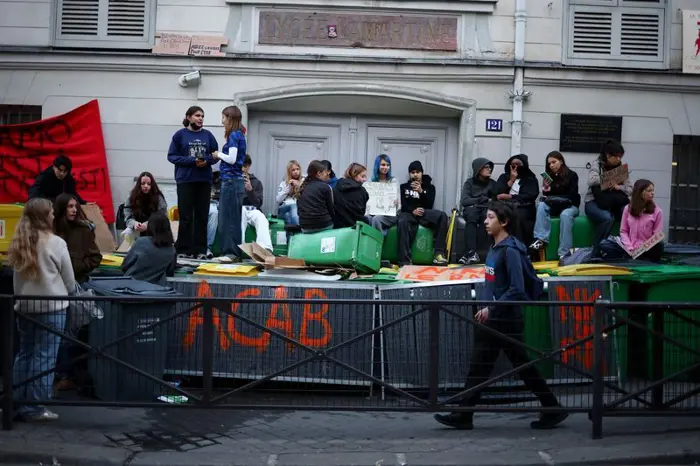
French high school students continued blocking schools on Thursday, keeping a nationwide protest movement alive despite government promises to respond to concerns over teacher shortages, deteriorating school buildings and underfunded public services.
The demonstrations, now entering their third week, have become a wider reflection of growing frustration among young people who say France’s public education system needs urgent investment. At the same time, the government is facing intense financial pressure to reduce the country’s debt and deficit, creating a difficult balance between public demands and economic constraints.
The protests have also raised serious concerns over public order and the use of force against teenagers. Hundreds of people have been arrested and dozens injured since the movement began. On Wednesday, authorities suspended the use of stun grenades during efforts to control the demonstrations.
According to France’s education ministry, 224 high schools were closed on Thursday morning, while another 151 were partially reopening following earlier disruptions. The number of closures had fallen by around 30 percent compared with Wednesday, with the ministry reporting that 94 percent of high schools were either fully or partially open.
In Paris, tensions remained visible around Hélène Boucher High School in the 20th arrondissement. Protesters built a barricade using rubbish bins, chanted slogans and displayed banners as police arrived. Scuffles were reported between demonstrators and officers.
Student demonstrations supported by teachers and trade unions were scheduled across the country, including a gathering at Paris’s Place de la Bastille. The latest protests came only two days after hundreds of thousands of people joined demonstrations nationwide.
Political tensions grow as election approaches
Thursday’s turnout is being closely watched because it could indicate whether the government’s efforts to calm the situation are having an impact. Trade unions, however, are already preparing for another major day of demonstrations on October 17.
Prime Minister Sébastien Lecornu addressed the country late Wednesday and promised that the government would deliver “concrete, quick and fully funded responses” by the end of October. However, he did not provide specific measures or explain exactly how the government intends to meet the students’ demands.
An online consultation launched by the government to allow high school students to describe their concerns and propose demands received more than 43,000 responses within its first two days, showing the level of engagement surrounding the issue.
The protests are also unfolding just six months before an election to choose France’s next president after Emmanuel Macron completes his second consecutive term. Political reactions have become increasingly divided.
Far-right leader Marine Le Pen has focused attention on damage to schools allegedly caused by a minority of protesters and argued that students or their parents should be responsible for repair costs. She has also presented plans aimed at reducing government spending.
Meanwhile, hard-left leader Jean-Luc Mélenchon received an enthusiastic reception during a Paris demonstration. He praised the protesting students and accused authorities of using excessive force against demonstrators.
Public opinion appears equally divided. An Elabe poll for BFM TV found that 72 percent of French people considered the students’ demands legitimate, while 55 percent believed the protests should now end.
Government faces pressure to respond
The government has attempted to maintain a difficult middle ground. Officials have condemned violent incidents, including cases involving fires at schools and injuries to staff, while acknowledging that students have genuine concerns about the condition of the education system.
Finance Minister Roland Lescure said the government had a responsibility to listen to young people. He also acknowledged the difficulty of telling younger generations that there is not enough money for their needs while significant public spending is directed toward healthcare and pensions.
The debate has therefore moved beyond school buildings and teacher shortages. It has become part of a much larger conversation about how France distributes public resources between generations and how much the government can realistically spend while trying to control its finances.
The unrest is not limited to France. Student and teacher demonstrations were also reported in Belgium, Spain and Portugal on Wednesday.
In Belgium, authorities in Liège imposed restrictions on public gatherings of more than three people until October 16 following a series of student protests. Local media reported that more than 100 people had been arrested in connection with demonstrations in the city this month.
Belgian Foreign Minister Bernard Quintin said Thursday that hard-left activists had infiltrated some demonstrations and were responsible for property damage.
For many French students, however, the central issue remains much simpler: they want to know whether the government will turn its promises into visible changes. With schools still facing closures, political divisions deepening and unions preparing further demonstrations, the coming weeks could determine whether the current protest movement fades away or becomes a much broader challenge for France’s next political leadership.