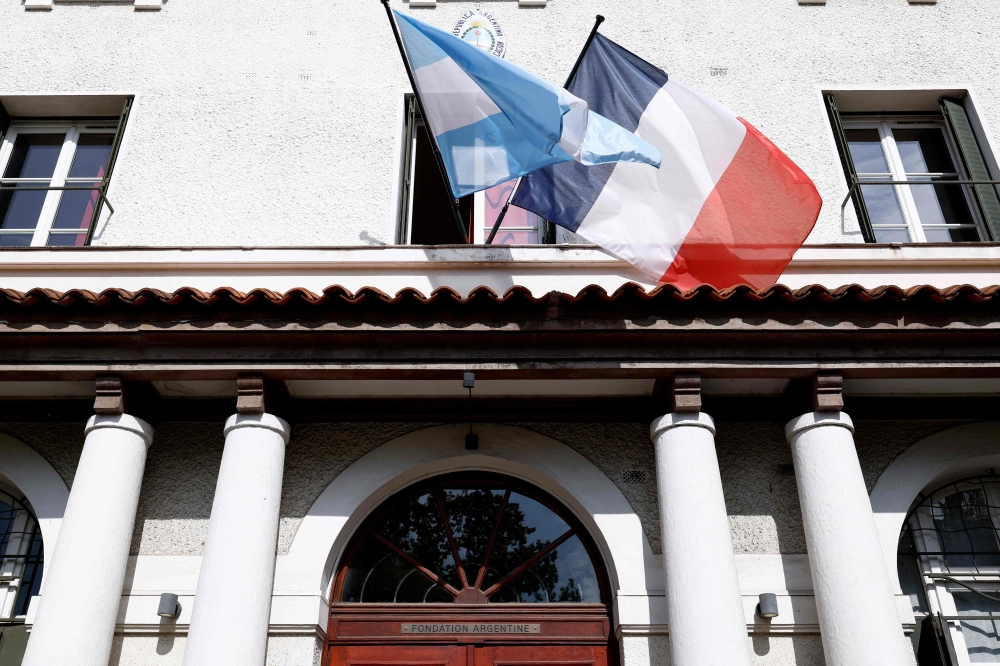
An Argentine-run student residence in Paris is facing growing scrutiny over allegations that student freedoms have been restricted and that the building has been used to host meetings involving European far-right groups.
The controversy comes just weeks before Argentine President Javier Milei is expected to visit France, putting renewed attention on Argentina House, a residence located within the historic Cité Internationale Universitaire de Paris.
The residence is meant to be part of an international community built around cultural exchange, friendship and peaceful coexistence. But current and former residents, as well as people familiar with the campus, say the atmosphere at Argentina House has changed significantly since Santiago Muzio, a lawyer and strong Catholic who was appointed director in 2024, took charge.
One former resident described the residence as having changed from a place centred on community, culture and art into an environment dominated by fear, control and surveillance.
Other students alleged that access to shared spaces, including the lounge and outdoor barbecue area, became more restricted. Some also claimed they felt uncomfortable discussing issues such as LGBTQ rights or Argentina’s history of military rule.
One former resident went as far as describing the environment as a “mini-dictatorship”.
Concerns over far-right meetings
The controversy has also expanded beyond the management of student life.
Reports have alleged that Argentina House has hosted gatherings involving European far-right figures and organisations. According to the French outlet Basta!, two think tanks associated with the far right in Poland and Hungary reportedly met at the residence in November to discuss proposals aimed at significantly reducing the role of the European Union.
The residence also reportedly hosted a meeting in May focused on opposition to euthanasia in Europe.
The allegations have attracted attention from French officials and the organisation responsible for managing the Cité Universitaire.
Blandine Sorbe, representing the foundation overseeing the campus, said she was seeking to have concerns about the residence’s management addressed through diplomatic channels before Milei’s expected visit to Paris.
Paris city officials have also asked the French foreign ministry to investigate the situation.
French Foreign Minister Jean-Noël Barrot said officials were already in discussions with Argentine authorities and their representatives in Paris.
Argentina House and Argentina’s Ministry of Human Capital, which has authority over the residence, did not respond to repeated requests for comment from AFP.
Dispute over campus values
The Cité Internationale Universitaire is home to roughly 12,000 students, academics and artists from around 150 nationalities. Its international character is built around bringing people from different cultures and backgrounds together.
Argentina House has been part of that tradition since opening in 1928. Over the decades, it has welcomed generations of students and intellectuals, including Argentine-French writer Julio Cortázar.
Today, residents reportedly pay between €620 and €1,210 a month for accommodation, depending on the room and arrangement.
Like other residences on the campus, Argentina House is expected to follow the Cité U’s charter of values, which promotes human rights, privacy and non-discrimination, including on the basis of gender or sexual orientation.
According to Laurent Schneider, a representative connected with the residence, Muzio has refused to sign the charter.
Schneider said Muzio could not, “in good conscience,” sign a document that recognises gender equality and non-discrimination based on sexual orientation.
A source familiar with the residence also alleged that posters supporting LGBTQ rights were removed.
A plaque becomes a flashpoint
Tensions escalated further in February when a plaque commemorating people who disappeared or were victims of state terrorism during Argentina’s military dictatorship was removed from Argentina House.
The plaque referred to 30,000 disappeared people and victims of state terrorism between 1974 and 1983. Milei’s government disputes that figure and maintains that the number of victims was significantly lower.
The residence said the plaque was removed because of construction work.
The decision nevertheless triggered a reaction among students. A commemoration was held at Germany House, another residence on the campus, and Cité U authorities later installed a similar plaque nearby.
Campus sources also told AFP that 13 students who were seen as opposing the plaque’s removal were not permitted to remain at Argentina House during the summer holidays.
One of them, academic researcher Salvador Calanni, described the experience as “political persecution”.
Sorbe said that around 10 students affected by the situation were rehoused during July and August.
But the dispute did not end there.
When applications opened for the new academic year, Calanni said he was among 42 applicants rejected by Argentina House. He described the admissions process as unclear and lacking transparency.
A wider question about student freedom
The dispute at Argentina House has raised broader questions about how international student residences should balance institutional independence with the shared values of the Cité Internationale Universitaire.
The campus was established after World War I with an ambitious idea: bring young people from different countries together so that personal relationships could help build greater international understanding.
That mission makes the allegations particularly sensitive.
A director of another residence told AFP that he could no longer recommend Argentina House to students because of concerns about the environment there.
The issue now sits at the intersection of student life, diplomatic relations, political ideology and freedom of expression.
For students living thousands of kilometres from home, a university residence is more than a bed and a room. It is supposed to be a place where people can study, build friendships, debate ideas and feel secure.
The growing scrutiny of Argentina House shows how quickly that sense of community can become a political issue when questions about freedom, identity and ideology enter everyday student life.
As French and Argentine authorities continue discussions, attention will now turn to whether the concerns raised by students and campus officials lead to a formal investigation and what, if anything, changes at the residence.
For the students who live there, however, the issue is much more immediate: they want to know whether a place designed to bring different people together still feels like a home where they can freely be themselves.