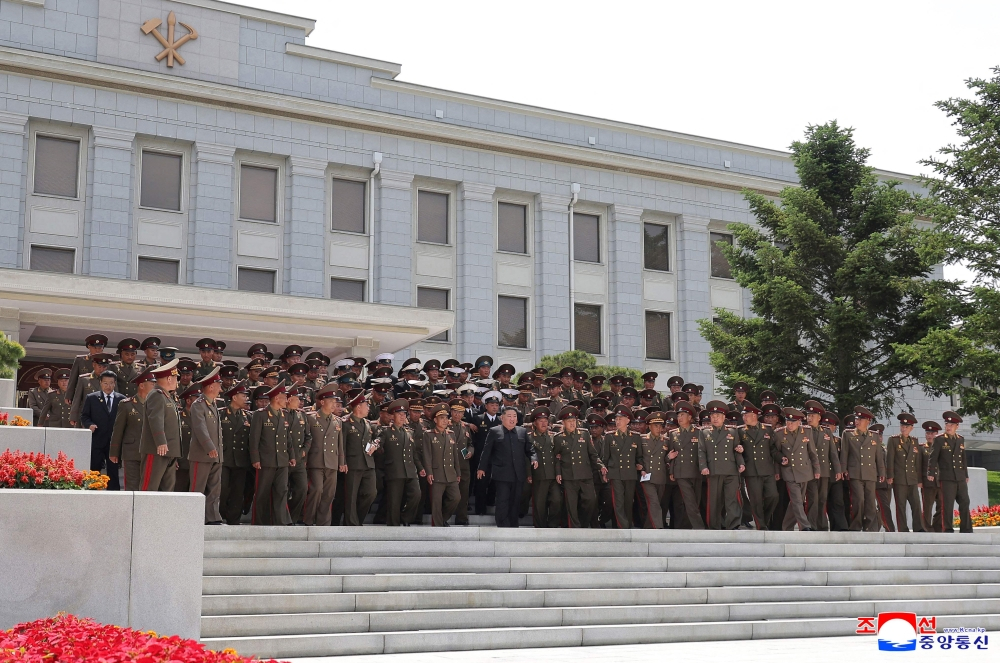
North Korean leader Kim Jong Un has directed senior military officials to significantly strengthen frontline forces and reinforce the country’s southern border, describing it as part of a broader push to turn the area into an “impregnable fortress,” according to state media reports.
The instruction was issued during a high-level military meeting held the previous day, where images released by the Korean Central News Agency (KCNA) showed Kim presiding over uniformed commanding officers in a formal setting.
During the meeting, Kim emphasized what he called the need for a “great change” in military preparedness, urging officers to reshape their perception of what he referred to as an “arch enemy,” widely understood as a reference to South Korea.
He reportedly outlined plans aimed at strengthening frontline units both operationally and technologically, framing the initiative as a key step to prevent the possibility of war and improve national defense readiness.
The broader military modernization strategy, according to KCNA, includes redefining operational doctrines across multiple branches and enhancing the capability of major units stationed near the southern border.
Analysts suggest these developments may reflect lessons drawn from modern conflicts, including Russia’s ongoing war in Ukraine, where North Korea has reportedly provided support to Moscow. Experts believe such conflicts are influencing Pyongyang’s evolving defense mindset.
Hong Min, a senior researcher at the Korea Institute for National Unification, noted that the language used by North Korean leadership indicates growing attention to modern warfare tactics such as drones, precision strikes, electronic warfare, and multi-domain operations spanning land, sea, air, cyber, and even space domains.
Interestingly, these military remarks came on the same day that the North Korean women’s football team arrived in South Korea, marking their first visit in eight years and briefly raising hopes for a possible easing of tensions between the two countries.
Despite such moments of cultural exchange, diplomatic relations remain strained, with Pyongyang showing little response to repeated dialogue offers from Seoul.
According to reports, Kim also stressed the need to modernize military capabilities and continuously adapt operational strategies to evolving global security challenges.
The situation highlights a deepening focus on military preparedness on the Korean Peninsula, even as occasional sporting and cultural interactions suggest fragile and limited contact between the two sides.