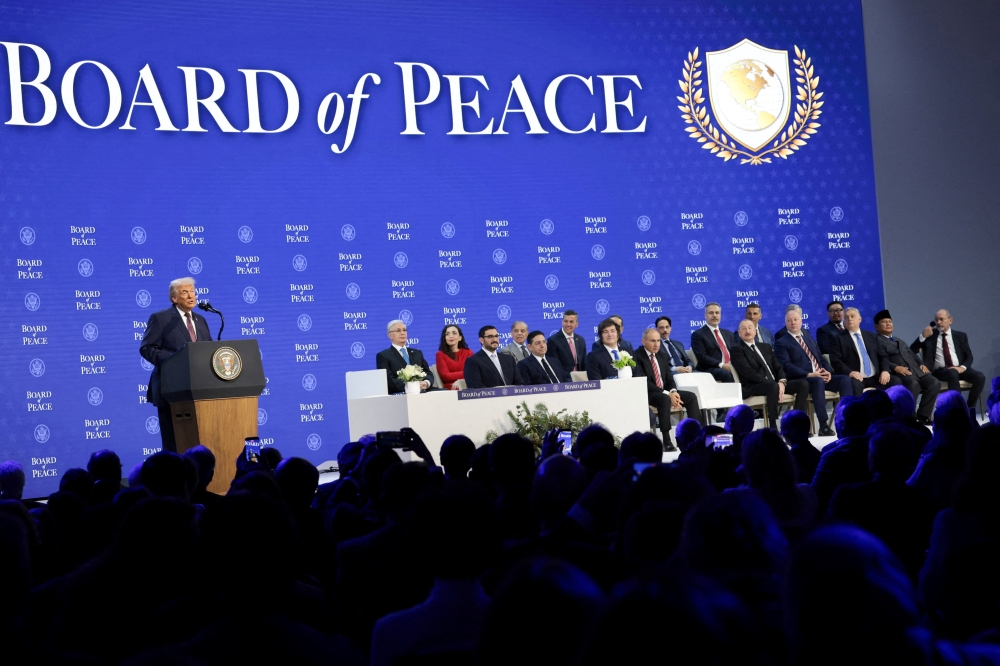
US President Donald Trump brought leaders from around the world to Washington this Thursday for the inauguration of his new international initiative, the “Board of Peace.” While the event places heavy emphasis on progress in Gaza, its ambitions extend far beyond a single conflict.
About two dozen officials — including heads of state and senior diplomats — attended the meeting. Notably absent were many traditional Western allies, especially from Europe, while several leaders known for more authoritarian leanings were present.
The idea for the “Board of Peace” emerged after the United States, Qatar, and Egypt successfully negotiated a ceasefire in Gaza last October, aiming to halt two years of intense conflict. Officials now say the initiative is moving into a second phase focused on disarming Hamas, the Palestinian group whose attack on Israel on October 7, 2023 triggered Israel’s wide-reaching military response.
According to Gaza’s health ministry, operating under Hamas authorities, fighting since the truce has left hundreds dead — highlighting the fragile nature of the current calm.
At the summit, Trump is expected to outline more than US$5 billion in pledges for rebuilding Gaza, a region where much of the infrastructure lies in ruins. Trump, known for his background in real estate, even suggested the idea of developing resorts in the territory — an idea some observers found surprising given the ongoing instability.
Another major focus of the talks is the creation of an International Stabilization Force to provide security and help rebuild the region. Indonesia, the world’s largest Muslim-majority country, has offered to send as many as 8,000 troops if the force is formally established. Indonesian President Prabowo Subianto attended both this summit and a related event earlier at the World Economic Forum in Davos.
U.S. officials, including Trump’s envoy Steve Witkoff, have expressed confidence that progress is being made and that pressure is building on Hamas to begin giving up weapons. But experts point out that fully disarming a deeply entrenched militant group is complex and difficult.
Israeli leaders, represented at the meeting by the foreign minister, have pushed for restrictions that include collecting weapons such as rifles from Hamas fighters — a step that Israeli Prime Minister Benjamin Netanyahu has described as crucial to reducing violence.
In parallel with these efforts, a technocratic committee has been established to oversee day‑to‑day governance in Gaza, led by engineer and former official Ali Shaath.
Meanwhile, Hamas officials criticized the summit, calling on the “Board of Peace” to push Israel to stop what it described as ongoing violations in Gaza and end the long‑standing blockade.
Some analysts have described the initiative as a blend of bold ambition and personal interest from Trump. The “Board of Peace” operates out of the U.S. Institute of Peace, a long‑standing conflict resolution organization whose staff was dismissed by Trump, who later had his name added to the building’s entrance.
According to the White House, Trump will have veto power over the Board’s decisions and may even continue leading the institution after leaving office. Countries wishing to retain permanent membership — rather than rotating every two years — would need to contribute US$1 billion.
While the United States frames the summit as a step toward peace, critics see it as overly broad and lacking in clear strategy. Some argue it reflects Trump’s broader approach of reducing U.S. engagement with multilateral organizations like the United Nations.
Notable attendees included Hungarian Prime Minister Viktor Orban and Argentinian President Javier Milei, both seen as political allies of Trump. Leaders from Pakistan and other nations also joined in hopes of strengthening ties with Washington.
Yet several long‑standing U.S. partners — including France, Canada, and Brazil — either declined invitations or sent lower‑level representatives, underscoring divisions within the global community about the Board’s purpose and structure.
In the end, the “Board of Peace” summit represents a blend of diplomatic effort, political ambition, and international debate about how best to seek stability in one of the world’s most challenging conflict zones. Whether it leads to lasting peace — or simply another chapter in a long, difficult process — remains to be seen.