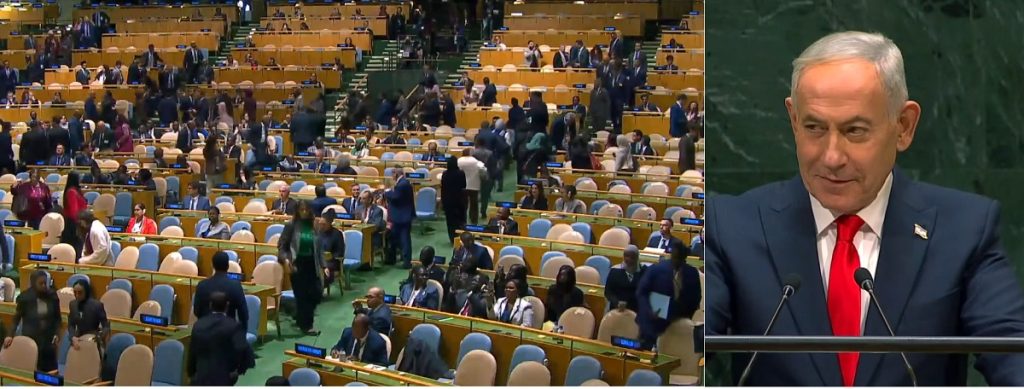
Israeli Prime Minister Benjamin Netanyahu delivered a forceful and highly contentious address at the United Nations General Assembly on Thursday, as the conflict in Gaza and Israel’s military confrontation with Iran remained at the centre of international attention.
His appearance was anything but routine. As Netanyahu began speaking, numerous delegates left the General Assembly hall, while others remained seated amid a visibly divided atmosphere. The walkouts underscored the deep international disagreement surrounding Israel’s actions in Gaza and its wider military campaign in the region.
Netanyahu used his speech to strongly reject accusations that Israel is committing genocide in Gaza, describing such allegations as “the biggest lie of the century.” He defended Israel’s military decisions and argued that the country had acted in response to serious security threats.
Addressing the delegates who left the chamber, Netanyahu said that those who remained should also leave if they were unwilling to hear Israel’s position. His remarks reflected the increasingly confrontational tone surrounding Israel’s relationship with parts of the international community.
Netanyahu also spoke about Israel’s decision to attack Iran, describing it as “one of the easiest decisions I’ve ever had to make.” He portrayed the action as necessary for Israel’s security and criticized those who opposed it.
The speech came as diplomatic efforts over Gaza continued. Hamas said it was prepared to move forward with a proposed peace agreement, adding another layer of uncertainty to an already complicated diplomatic process. At the same time, a senior European Union official said that only a small portion of the financial resources required to rebuild Gaza had been secured.
For people watching the crisis from outside the region, the developments can be difficult to separate from the wider political and humanitarian picture. Behind the speeches, diplomatic statements and international disputes are millions of civilians whose lives have been profoundly affected by the continuing conflict.
Palestinian President Mahmoud Abbas also addressed the United Nations, although he did not appear in person. According to the material provided, the United States again denied him a visa to attend the General Assembly, meaning his remarks were delivered through a prerecorded video.
Abbas used the address to emphasize that Palestinians would not accept displacement or abandon their homeland. “We will not leave our homeland. We will not accept displacement. And we will not allow anyone to decide our future on our behalf,” he said.
He also called for stronger international action concerning the situation in Gaza and the wider Israeli-Palestinian conflict. His appearance came amid continued international attention on the humanitarian situation facing Palestinians.
The contrasting appearances of Netanyahu and Abbas highlighted how sharply divided the diplomatic debate remains. Netanyahu focused on Israel’s security and its rejection of allegations of genocide, while Abbas emphasized Palestinian rights, the prevention of displacement and the need for international action.
The scenes inside the UN General Assembly offered a powerful reminder that diplomacy does not always produce agreement. Sometimes, it simply provides a stage where competing versions of the same crisis are presented before the world.
For ordinary families affected by the conflict, however, these diplomatic confrontations have consequences far beyond the walls of the United Nations. Questions about security, displacement, humanitarian assistance, rebuilding and a possible political settlement remain deeply connected to the daily realities of people living through the crisis.
As diplomatic discussions continue, attention remains focused on whether negotiations can produce meaningful progress toward ending the fighting, protecting civilians and creating a pathway toward a more lasting political solution.
The latest developments at the United Nations therefore represent more than another headline from an international summit. They reflect a conflict that continues to divide governments, challenge diplomacy and shape the lives of people across the Middle East.