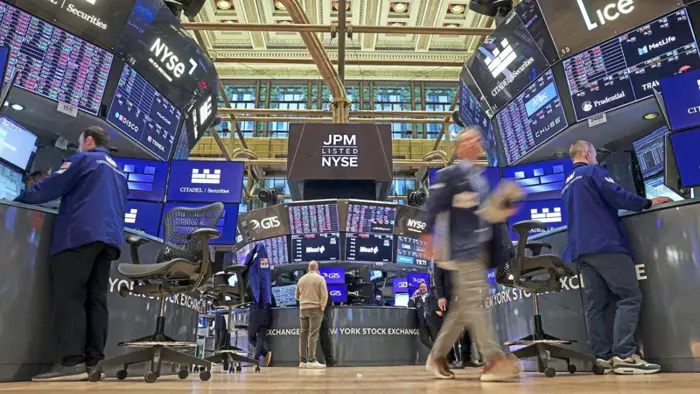
Wall Street was heading for a cautious start on Monday as renewed military attacks between the United States and Iran pushed oil prices higher and revived concerns about inflation.
The rise in energy prices comes at an uncomfortable time for investors. Markets are already preparing for a more uncertain interest-rate outlook, with traders increasingly concerned that the Federal Reserve could keep monetary policy tighter for longer if inflation remains above its 2% target.
U.S. stock index futures moved lower before the opening bell. Dow Jones futures fell 51 points, or 0.10%, while S&P 500 futures declined 10 points, or 0.13%. Nasdaq 100 futures slipped 12.5 points, or 0.04%.
The pressure on markets follows renewed military strikes in the Middle East, with disruption around the Strait of Hormuz affecting oil shipments. Brent crude jumped around 2%, adding another layer of uncertainty for investors and businesses already dealing with elevated costs.
The bigger concern is what higher oil prices could mean for inflation.
When energy prices rise sharply, the impact can spread across transportation, manufacturing, logistics and consumer goods. That could make the Federal Reserve’s inflation battle more difficult and complicate expectations surrounding interest rates.
Investors turn their attention to the Federal Reserve
The interest-rate debate has become increasingly sensitive following comments from Federal Reserve Chair Kevin Warsh.
Warsh indicated that policymakers could consider raising interest rates if inflation fails to move closer to the central bank’s 2% target. His comments were viewed by investors as more hawkish than expected and have changed the tone of the market.
According to the CME FedWatch tool, traders were seeing almost a 60% probability of a rate hike at the September meeting, up significantly from 41.4% just one week earlier.
David Chao, global market strategist for Asia Pacific at Invesco, said Warsh’s remarks made it clear that investors should not expect an immediate shift toward easier monetary policy.
The comments came during Warsh’s first appearance at the Federal Reserve’s annual Jackson Hole symposium on Friday.
The challenge for policymakers is that recent economic data has delivered a mixed picture.
A consumer inflation report earlier this month suggested that price pressures were relatively mild. However, the Personal Consumption Expenditures index, which the Federal Reserve closely watches as its preferred inflation gauge, came in hotter than economists had expected.
That leaves investors looking closely at the next major economic releases.
Jobs data could become the next major market test
The U.S. employment report scheduled for September 4 is expected to receive particular attention.
Investors will be watching nonfarm payrolls, wage growth and other labor-market indicators for clues about whether the economy is cooling enough to reduce inflationary pressure or whether economic strength could give the Federal Reserve another reason to maintain or increase interest rates.
Kyle Rodda, senior financial market analyst at Capital.com, said market participants were approaching the employment report with greater caution because monetary policy uncertainty has increased.
For Wall Street, the timing could hardly be more important.
September has historically been a challenging month for U.S. equities, and investors are now entering the month with several major risks sitting on the table at the same time: geopolitical escalation, higher oil prices, inflation uncertainty and a potentially more aggressive Federal Reserve.
Technology stocks show some resilience
Despite the broader weakness in futures, some major technology and semiconductor stocks were showing strength before the market opened.
Nvidia gained 0.72% and was the only advancing stock among the so-called Magnificent Seven group at the time of the report.
Other semiconductor companies also moved higher. Intel gained 1.73%, Lam Research rose 1.00%, and Texas Instruments advanced 0.92%.
The continued interest in artificial intelligence and digital infrastructure is providing some support for technology-related stocks, even as investors remain cautious about the wider economic environment.
Invesco’s David Chao said he continued to favor parts of the market connected to structural growth themes, particularly artificial intelligence and digital infrastructure.
Energy companies benefit from higher oil prices
The jump in crude prices provided a boost to energy stocks.
Halliburton rose 2.46%, while Valero Energy gained 2.17% before the opening bell.
The moves highlight the very different ways markets can react to geopolitical shocks. Higher oil prices may hurt consumers and companies that depend heavily on energy, while producers and other parts of the energy industry can benefit from stronger crude prices.
The situation around the Strait of Hormuz remains particularly important because the waterway is a major route for global oil shipments. Any prolonged disruption could create additional pressure on global energy markets.
Crypto stocks move higher
Cryptocurrency-related companies were also mostly higher.
Bitcoin remained above $78,000, while Coinbase, Strategy and CleanSpark posted gains ranging from roughly 0.97% to 1.92%.
The strength in crypto-related equities came even as traditional markets faced pressure, showing that investors continue to watch digital assets closely during periods of major geopolitical and macroeconomic uncertainty.
What investors are watching now
The immediate focus for markets is likely to remain on three major developments.
First, investors will watch whether the conflict between the United States and Iran causes further disruption to energy supplies.
Second, oil prices will remain critical because a sustained increase could make the fight against inflation more difficult.
Third, the Federal Reserve’s next moves will depend heavily on incoming economic data, particularly inflation and employment figures.
The upcoming U.S. jobs report could therefore become one of the most important market events of the week.
For everyday investors, the latest market moves are a reminder that financial markets do not operate in isolation. A geopolitical conflict thousands of miles away can quickly influence oil prices, inflation expectations, borrowing costs, company profits and ultimately the value of investments.
Wall Street’s reaction on Monday is not simply about a few percentage points in stock futures. It reflects a much bigger question facing global markets: can inflation continue to cool while geopolitical tensions and energy prices are moving in the opposite direction?
For now, investors appear to be choosing caution.
The coming days could provide a clearer picture of whether this is a short-term market reaction or the beginning of a more sustained shift in expectations for inflation, interest rates and economic growth.