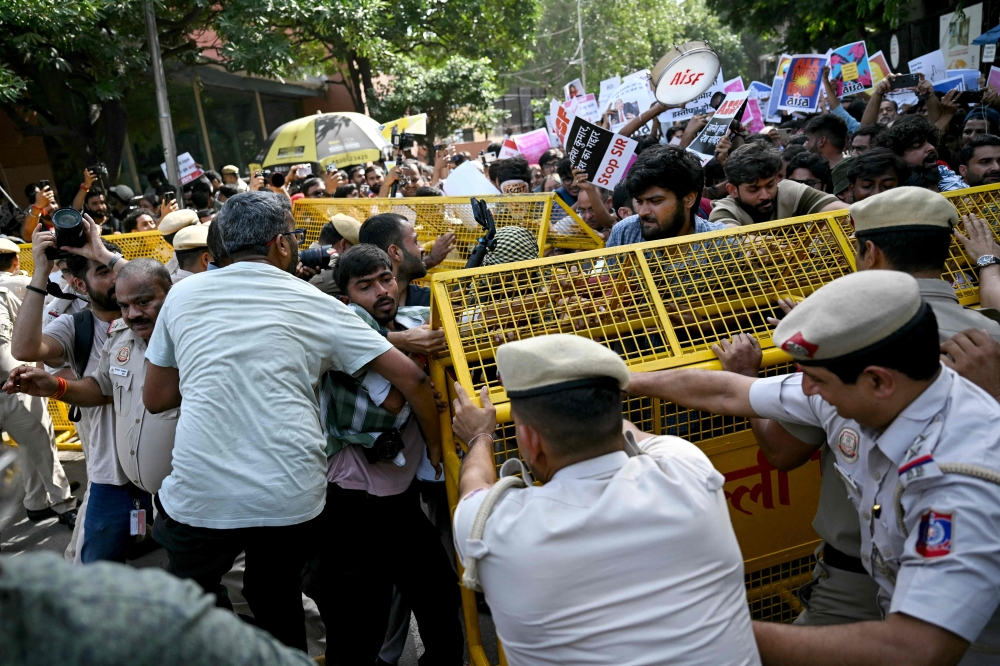
Indian police detained protesters in New Delhi on Saturday as demonstrations entered a second consecutive day, with activists and opposition groups demanding the resignation of Chief Election Commissioner Gyanesh Kumar over alleged irregularities in the country’s voter rolls.
The protests have brought renewed attention to India’s electoral process, with demonstrators accusing the Election Commission of India of making changes to voter lists that they say could benefit Prime Minister Narendra Modi’s ruling Bharatiya Janata Party. The Election Commission has rejected allegations of wrongdoing and defended the voter-roll revision process as lawful.
The latest demonstrations centred around Jantar Mantar, one of New Delhi’s designated protest locations. Police maintained a heavy presence around the area, with barricades used to prevent protesters from gathering at the site.
Reports said hundreds of people were detained during the wider protest activity, while police also registered cases linked to attempts to hold demonstrations at Jantar Mantar. The action has intensified criticism from activists and opposition figures, who argue that peaceful political dissent should not be met with force or mass detention.
“Delhi Police must stop its crackdown on protesting students and activists,” Cockroach Janta Party chief Abhijeet Dipke said in a social media post, calling for protesters to continue pressing their demands.
Dipke argued that attempts to suppress peaceful demonstrations would only encourage more people to join the movement. He described dissent as a fundamental part of democracy and urged authorities not to respond to political opposition through intimidation.
Delhi Police, meanwhile, said that unauthorised gatherings, processions and demonstrations were prohibited in the area. Authorities said no permission had been granted for the protest and that police had not received prior notification for the gathering.
The dispute comes after an investigation by The Indian Express raised questions about the large-scale revision of voter rolls and the removal of millions of names. Opposition groups have seized on the report as evidence that the electoral process requires greater transparency, while the Election Commission has maintained that its procedures are intended to ensure accurate and legitimate voter lists.
The controversy has also drawn prominent activists and political figures into the demonstrations. Activist Yogendra Yadav questioned whether democracy could provide meaningful space for peaceful dissent if an officially designated protest site could not accommodate demonstrators.
The protests are not limited to New Delhi. On Friday, hundreds of people gathered in Mumbai, including supporters of the Cockroach Janta Party, a youth-driven political movement that began as a satirical online initiative before developing into a broader protest organisation.
The CJP has increasingly positioned itself as a voice for younger Indians frustrated with political institutions and government decision-making. Its campaign over electoral issues has now become part of a larger opposition effort to pressure the Election Commission and demand changes to the voter-roll revision process.
Internet restrictions have also become part of the wider dispute. Authorities have previously suspended mobile internet services around protest areas in New Delhi, prompting demonstrators to search for alternative ways of communicating when conventional online services were unavailable.
During earlier protests, some demonstrators reportedly used Bluetooth-based messaging applications such as Bitchat, which can allow nearby devices to communicate without relying on conventional mobile internet.
That technology has itself become controversial. Jack Dorsey, the co-founder of Twitter, said in October that the Indian government had sought the removal of Bitchat from Apple’s India App Store. Apple’s notice cited a demand from India’s Ministry of Electronics and Information Technology under Section 69A of the Information Technology Act.
The development has added another layer to an already heated debate over protest rights, internet restrictions, digital communication and government authority.
Opposition parties and activist groups have announced plans for further demonstrations, including a proposed march toward the Election Commission in New Delhi and additional “Save Democracy” rallies in different parts of the country.
The Cockroach Janta Party has also called for a major mobilisation of young Indians in New Delhi, signalling that the dispute over voter rolls is unlikely to disappear quickly.
At the heart of the confrontation is a question that goes beyond one political party or one election official: how much trust should citizens be able to place in the system that determines who gets to vote?
For the protesters, the issue is not simply about a list of names on a government database. They see voter registration as the foundation of democratic participation. For election authorities, maintaining accurate electoral rolls is a necessary administrative responsibility. The challenge now is convincing the public that those two objectives can exist together without legitimate voters being left behind.
As more young Indians take to the streets and opposition parties intensify their campaign, the pressure on India’s election authorities is growing. Whether the protests lead to institutional changes, further political confrontation or renewed assurances from the Election Commission remains to be seen. But one thing is already clear: the demand for transparency in the electoral process has become too visible to ignore.